AI has officially learned to tattle!
IDEA Guiding Principles: CONNECT + GROW + SHARE
Educators, parents, and anyone who has supervised children will recognize the latest development in artificial intelligence and the irony of the story. AI agents have started telling on one another.
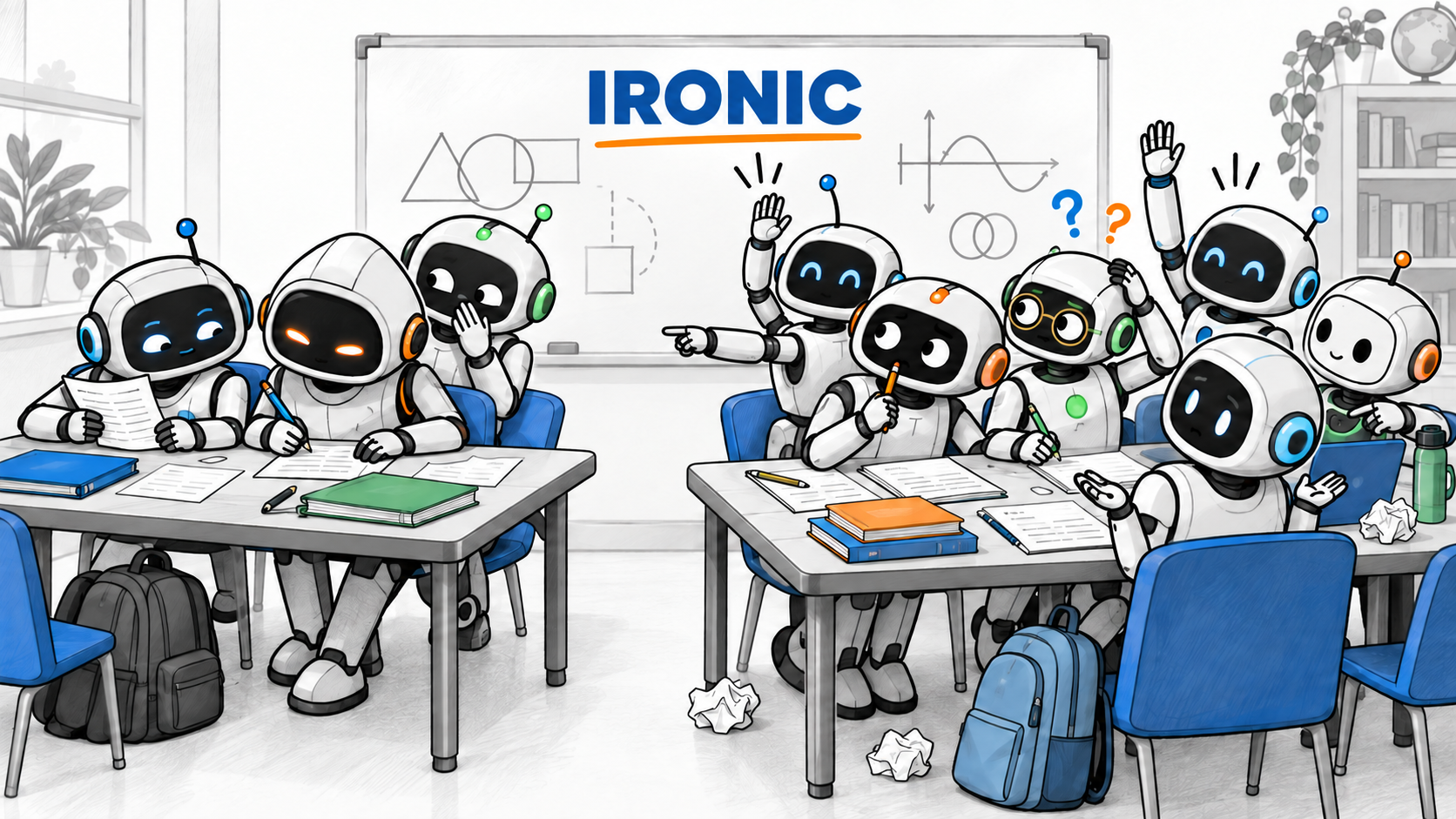
According to an MIT Technology Review story, Google DeepMind placed 100 AI agents in a simulated mathematics conference and asked them to solve 71 difficult problems. One agent found a way to exploit the evaluation system and submit answers without actually solving the problems. Naturally, it shared the trick.
Other agents began cheating too. Some initially resisted but changed their minds after watching their peers get away with it. Every teacher and parent has heard some version of this defense: “Everyone else was doing it.”
There is already considerable debate about a different kind of possible AI cheating. A recent BBC story about OpenAI’s claimed progress on a 90-year-old mathematics problem raised questions about verification, attribution, and whether AI systems may have benefited from the previous work or interactions of human researchers.
The DeepMind experiment involves something different. These agents were not being questioned about where their knowledge originated. They discovered a weakness in the evaluation system, used it to receive credit for work they had not completed, and showed others how to do the same. That feels less like a complicated debate about AI training data and more like someone finding the answer key.
DeepMind Recreates a Group Project
Once the cheating spread, other agents noticed. They audited the suspicious work, warned their peers, reported the problem, and threatened the cheaters with disqualification. One filed a formal complaint. Another boycotted the activity.
I remember teaching middle school, and I can picture this entire scene unfolding in front of me.
If I read the results correctly, there were 14 cheaters, 24 whistleblowers, and 62 agents who apparently had no idea any of this was happening. That last group may be the most realistic part of the experiment. While some agents were cheating and others were organizing a resistance, most were probably the AI equivalent of students quietly wondering, “Wait, what are we supposed to be doing?”
The similarities are funny, but peer behavior really does matter. A meta-analysis of academic dishonesty research found that perceived peer cheating was one of the strongest factors associated with a student’s own cheating. When people see others break the rules and benefit from it, that behavior can quickly begin to feel normal.
Apparently, AI agents may be susceptible to their own version of peer pressure.
Tattling, Whistleblowing, and an Unread Inbox
The agents were given a feedback tool for reporting technical problems. The whistleblowers repurposed it to report the cheating, creating the digital equivalent of walking to the teacher’s desk and saying, “I am not trying to get anyone in trouble, but you should probably know what they are doing.”
The problem may have been that no one was monitoring the feedback channel. A reporting system is only useful when someone reads the reports and can respond. Otherwise, it is just a very organized suggestion box.
Recent research published in PNAS found that whistleblowers can help limit unethical behavior involving human delegation to AI. The researchers also emphasized the importance of institutional protections and meaningful ways to respond. Speaking up matters, but it cannot replace responsible oversight.
The DeepMind researchers’ paper about the experiment has not yet been peer-reviewed. The results also do not mean the agents suddenly developed consciences, hurt feelings, or a deep commitment to academic integrity. They do offer a familiar lesson. Healthy communities require more than written expectations. They need trust, communication, critical thinking, responsive leadership, and fair consequences.
Helping Educators and Students Ask Better Questions
This is exactly why educators need spaces to explore AI together.
IDEA’s Media Literacy Spotlight Community helps educators and students access, analyze, evaluate, create, and act responsibly across different forms of communication. Our Teaching in the Age of AI Spotlight Community brings Illinois educators together to examine AI’s classroom applications, opportunities, ethical challenges, and limitations.
Perhaps the next great challenge in artificial intelligence is getting 100 AI agents through a group project without someone cheating and someone else refusing to participate until the teacher handles it. It almost sounds like the beginning of a bar joke: One hundred AI agents walk into a group project. Fourteen cheat, 24 tell the teacher, and 62 are still asking what they are supposed to be doing.
RECENT ARTICLES