If Students Can Create It With AI, Can They Explain It?
IDEA Guiding Principles: GROW + SHARE + INSPIRE
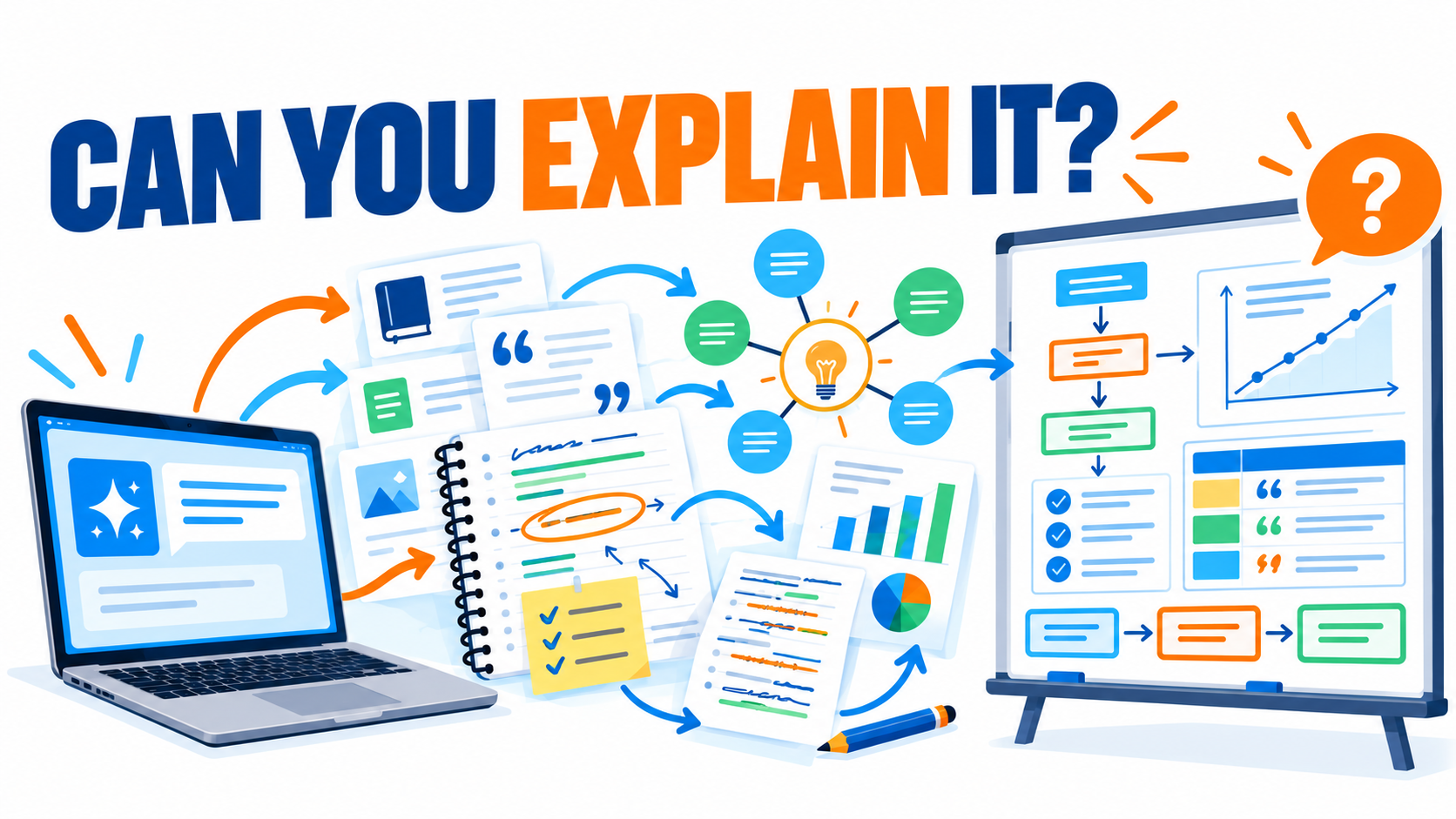
AI may be forcing education to confront a question we should have been asking long before artificial intelligence existed: How do we really know a student has learned something?
The Assessment Question AI Exposed
In a recent episode of Reach Every Student, educator Jon Bergmann sat down with Vicki Davis, known to many as the Cool Cat Teacher, to discuss artificial intelligence, academic integrity, and the future of assessment.
One idea from their conversation deserves particular attention. Students should be able to explain and defend the work they submit. If a student uses AI to generate computer code, for example, they should understand how that code works and why they made particular decisions.
That expectation seems reasonable, but it challenges how we have traditionally measured learning. For decades, educators have relied on completed assignments, essays, projects, and tests as evidence of understanding. Yet even before AI, a finished product could not always tell us what a student knew, how much assistance they received, or whether they could apply that knowledge independently. AI has made this challenge impossible to ignore.
From Monitoring Tools to Demonstrating Learning
In IDEA Illinois's recent article, Will Students Get Caught? A Prelude to What Is Coming!, we explored how emerging technologies, including wearable AI devices, are making traditional approaches to monitoring student work increasingly difficult. When assistance can come through glasses, headphones, or other devices, controlling the technology itself becomes less meaningful than understanding what the student actually learned.
Perhaps we have been asking the wrong question. Instead of focusing primarily on whether students used AI, we should be asking whether they developed meaningful understanding while using it
The question should shift from “Did AI help you?” to “What did you learn, and can you demonstrate it?”
This thinking also connects with Preparing Students for the World We Actually Created, where we argued that avoiding technology does not prepare students to use it responsibly. Students need opportunities to question AI-generated information, evaluate evidence, recognize limitations, and make thoughtful decisions about when technology adds value and when it does not.
AI Should Support Thinking, Not Replace It
Recent Illinois research adds another dimension to this conversation. A
2026 peer-reviewed publication involving University of Illinois Urbana-Champaign researchers Bill Cope and Mary Kalantzis introduced GenAI-by-Design, a framework for integrating generative AI into teaching and assessment. Drawing on mixed-methods research in graduate education, the authors examined how AI-supported feedback could complement human feedback while encouraging critical engagement and AI literacy. Their findings suggest opportunities for thoughtfully designed AI-supported learning while recognizing the importance of human judgment and student agency.
Although the research focuses on higher education rather than K–12 classrooms, its implications are worth exploring. Technology can provide feedback, generate possibilities, and support reflection, but students still need opportunities to make decisions, demonstrate understanding, and engage with educators.
IDEA contributor and Executive Board Secretary Steph Sukow made a related argument in Back to School with AI. She encouraged educators to move beyond using AI simply to generate answers and instead explore how it can support critical thinking, reflection, differentiated learning, and deeper understanding. Her examples remind us that the educational value of AI depends less on the tool itself and more on how educators design the learning experience.
Designing More Authentic Assessment
Imagine a classroom where students use AI to explore an idea, challenge its suggestions, improve their work, and explain the decisions they made. Assessment could include conversations, demonstrations, revisions, performances, and opportunities to apply knowledge in unfamiliar situations. These approaches do not eliminate the need for independent learning or traditional assessment. They expand the ways educators can recognize understanding.
We also need to recognize that students communicate and demonstrate learning differently. Asking students to defend their work should not become a rigid requirement that disadvantages learners who struggle with oral communication. The goal is not to create another obstacle. It is to provide meaningful ways for every student to demonstrate what they know.
This is precisely why conversations like the one between Bergmann and Davis matter. They encourage educators to move beyond the immediate anxiety surrounding AI-generated assignments and consider a much larger opportunity.
AI did not create our assessment challenges. It exposed them
Learning With Jon Bergmann and Vicki Davis
Jon Bergmann is also partnering with IDEA Illinois to offer the MasteryFlip Certification, a four-hour course designed to help educators address AI shortcuts, preserve productive struggle, and strengthen teacher-student relationships. Educators can learn more about the MasteryFlip course and the IDEA member discount through IDEA’s Teaching in the Age of AI community.
Vicki Davis continues sharing classroom-tested ideas about AI, educational technology, assessment, and meaningful learning through the Cool Cat Teacher website. Her work remains grounded in her experience as a practicing K–12 educator working directly with students and teachers.
Through IDEA Illinois's
Teaching in the Age of AI Spotlight Community, we want to bring educators together to explore these questions, share classroom experiences, and develop approaches that balance innovation with meaningful learning.
We do not need every educator to agree about AI. We need educators asking better questions together.
A Question for Educators: After listening to
Jon Bergmann's conversation with Vicki Davis, consider one question about your own classroom.
If students had to demonstrate their understanding rather than simply submit their work, what would you change about your teaching tomorrow?
Share this story
RECENT ARTICLES