Community Voice Can Help Shape Better Technology Decisions
IDEA Guiding Principles: CONNECT + GROW + SHARE + INSPIRE
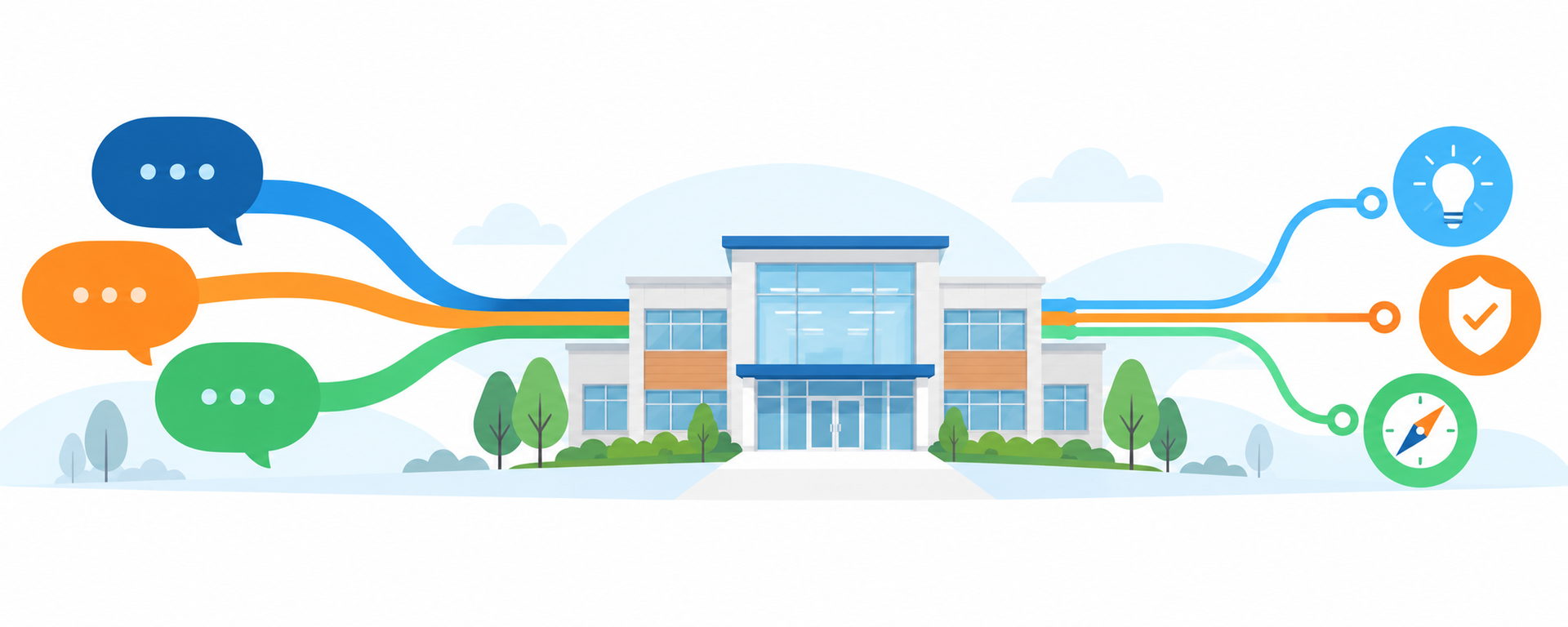
Schools have an important responsibility to involve their communities in conversations about technology.
Families, students, educators, and community partners should understand how technology supports learning, what questions schools are considering, and how students are being protected.
Each group brings a valuable perspective. Families understand their children, community values, and how technology affects life at home. Students know when technology helps them learn and when it becomes distracting. Educators understand curriculum, accessibility, assessment, and classroom practice, while technology leaders bring expertise in privacy, cybersecurity, infrastructure, and long-term planning.
The strongest decisions bring these perspectives together. The community can help clarify values, priorities, concerns, and desired outcomes. Educators and other professionals can then determine how those priorities are implemented safely and effectively.
The Institute of Education Sciences describes meaningful stakeholder engagement as an ongoing process. Schools should explain the purpose of the conversation, respond to feedback, show how it influenced decisions, and share what will happen next.
Schools Must Tell Their Story
Many conversations about education begin with the phrase, “When I was in school.” Those experiences matter, but today’s classrooms are preparing students for a very different world.
Communities need opportunities to see students using technology to create, collaborate, solve problems, and access support. They also deserve honest explanations about when technology strengthens learning, when a different approach works better, and how educators make those decisions.
A 2025 technology-in-schools study found that educators reported technology supporting collaboration, lesson delivery, curriculum planning, and student progress. The study was conducted in England, but it illustrates how much of technology’s value is found in classroom practices the public may not regularly see.
Schools do not have to tell this story through official announcements alone. Students and educators can show communities what learning looks like from inside the classroom. Class Intercom provides one example by helping students contribute to school social media through educator-managed approval processes. Along the way, students can develop skills in storytelling, media literacy, communication, and digital citizenship.
Students should not simply be the subjects of a school district’s story. They can be responsible contributors to it.
Listen, Show, and Learn Together
Community engagement is most valuable when it helps everyone develop a clearer picture of modern education. Schools can listen to community experiences, learn from educator expertise and research, show what learning looks like, identify shared priorities, and explain how feedback shapes the path forward.
Telling the story is not simply public relations. It is part of responsible stewardship. People can offer more informed feedback when they understand what schools are doing, why they are doing it, and how education has changed.
IDEA is creating opportunities to continue these conversations. On October 7, IDEA will host a webinar with Common Sense Media focused on navigating today’s digital world. On October 21, IDEA will host a webinar with Class Intercom exploring school storytelling, student voice, and community connection.
Details and registration will be available on the IDEA events page soon. The goal is not to suggest that more technology is always better. It is to bring communities and educators together around thoughtful decisions that support students. When schools listen well and share their stories clearly, community voice can become an important part of responsible and lasting progress.
IDEAs in Action
This is where IDEA can add value as an intermediary. We can connect schools, elevate educator and student voices, and help others seethoughtful learning practices firsthand. An initiative such as IDEAs in Action could move the conversation beyond descriptions of technology and into classrooms where people can observe, ask questions, and learn together.
The goal is not to suggest that more technology is always better. It is to help communities understand what schools are doing, give educators the support to make informed decisions, and prepare students for the world they already inhabit.
When schools listen well, share their stories clearly, and open opportunities
for others to learn from their work, community voice becomes part of responsible and lasting progress.
RECENT ARTICLES