An Ice Cream Hard Drive: Bringing Quantum Science Into an Illinois Classroom
IDEA Guiding Principles: Connect + SHARE + INSPIRE
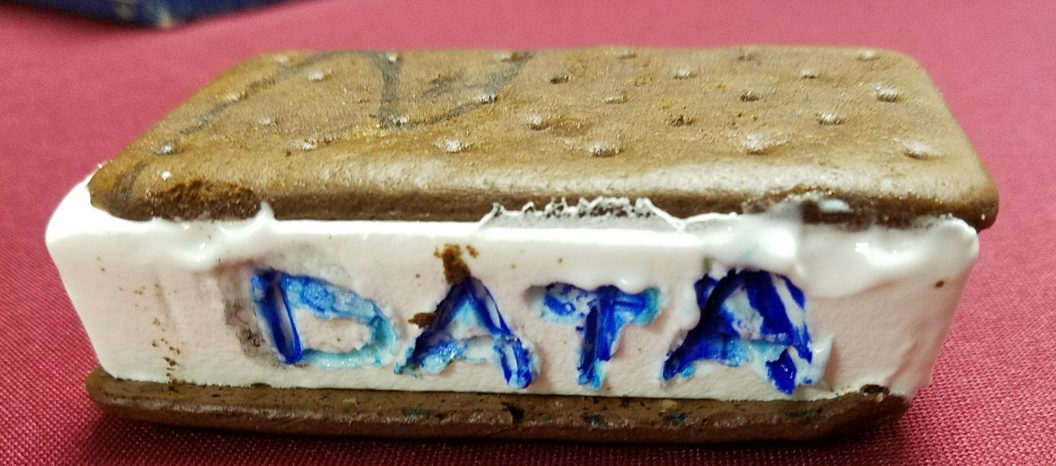
We were recently introduced to the work of Adam Davenport, science department chair at James H. Bowen High School in Chicago. Adam shared how he helps high school students explore quantum coherence, the fragile condition that allows quantum states to maintain the organized relationships needed for quantum information and computation. Heat, light, vibration, and other disturbances can disrupt those relationships, causing the system to lose coherence and the information it carries.
To make this difficult concept accessible, Adam writes a piece of “data” on the side of an ice cream sandwich and places it in a microwave. After the ice cream melts, the ingredients remain. Students can still see the chocolate wafers, ice cream, and smeared ink, but the structure that made the information readable has disappeared.
Students then use inexpensive materials from a local dollar store to build refrigerator systems that protect their ice cream hard drives from the classroom’s temperature. They test their designs and compare how long each system preserves the readable data. Students are not simply hearing about a challenge faced by quantum engineers. They are designing, testing, and improving possible solutions.
The University of Chicago’s recent profile of TeachQuantum educators explains how Adam and other teachers use familiar materials, carefully structured experiences, and local connections to make abstract quantum concepts more accessible.
The University of Chicago’s recent profile of TeachQuantum educators explains how Adam and other teachers use familiar materials, carefully structured experiences, and local connections to make abstract quantum concepts more accessible.
Masterfully Scaffolding Complex Learning
This lesson provides a powerful example for Illinois educators. Effective scaffolding does not make learning easier. It gives students a thoughtful pathway into intellectually demanding work that might otherwise feel inaccessible. Adam preserves the complexity of the science while changing how students enter it. They observe a familiar phenomenon, explain what they notice, connect those observations to scientific language, design a solution, evaluate evidence, and reconsider their thinking based on the results.
The ice cream sandwich is not simply a fun demonstration. It is a carefully selected starting point that prepares students to engage with a complex scientific concept. Adam has used the lesson in chemistry to explore energy transfer and materials science and in physics to support conversations about energy conservation and electromagnetism. Although quantum science does not appear explicitly within the Next Generation Science Standards, the lesson connects emerging content to established scientific practices.
An Extraordinary Opportunity for Students
The opportunity is particularly meaningful because the Illinois Quantum and Microelectronics Park is being developed less than two miles from Bowen High School. Illinois is investing in a quantum research, manufacturing, and workforce ecosystem on Chicago’s South Side.
For Bowen students, quantum science is becoming part of their neighborhood and potentially part of their future. Illinois universities are also creating pathways into the field. The
University of Illinois Urbana-Champaign’s Quantum Information Science minor brings together courses in physics, engineering, computer science, mathematics, and materials science. Students deserve opportunities to understand what is developing near their communities and to see how classroom learning can connect with future university programs and careers.
Teachers Building Curriculum for What Comes Next
For six years, Adam has worked with the University of Chicago’s TeachQuantum program. The program brings high school educators together with quantum researchers to design, pilot, revise, and share lessons introducing students to quantum science.
Adam has also developed an inexpensive three-dimensional Bloch sphere manipulative known as the Bloch Orb, or “BlOrb.” It costs approximately one dollar in materials and gives students another tangible way to begin developing intuition about an abstract idea.
The sophistication of Adam’s work is found in the instructional decisions behind it. He understands the science, anticipates where students may struggle, creates an accessible starting point, carefully sequences the learning, and maintains the integrity of the underlying concept.
His work connects closely with IDEA’s Modern Pedagogy & Assessment and Science of Learning Spotlight Communities. It demonstrates how educators can make complex and emerging subjects accessible without lowering expectations.
Illinois educators are preparing students for fields that are changing faster than curriculum standards can be revised. Meeting that challenge requires educators who can translate emerging knowledge into carefully scaffolded experiences that invite students into the learning.
We want to celebrate Adam for creating this opportunity for his students. We also want to hear from other Illinois educators providing students with access to advanced, emerging, or unexpected areas of learning. These stories deserve to be shared so educators across the state can learn from one another and more students can see themselves in what comes next.
About:
Adam Davenport
is the science department chair at James H. Bowen High School in Chicago. He is National Board Certified in Adolescence and Young Adulthood Physics and is one of the original members of the University of Chicago’s TeachQuantum program.
RECENT ARTICLES