Why Should Play Disappear as Students Get Older?
IDEA Guiding Principles: CONNECT + GROW + SHARE + INSPIRE
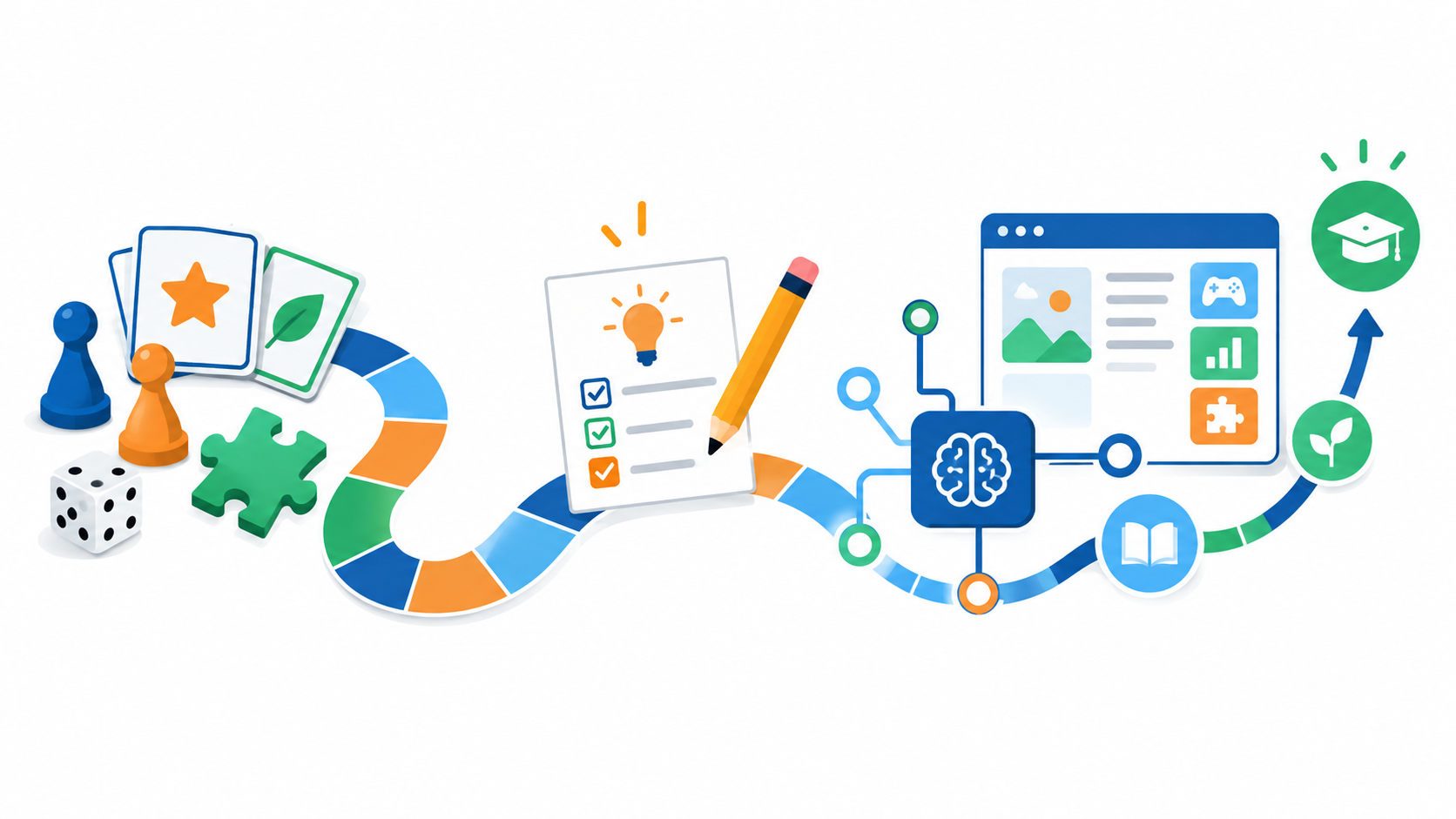
Young children are encouraged to build, imagine, experiment, move, and learn through play. As students get older, those experiences often give way to lectures, worksheets, and assignments with predetermined answers.
Why should the foundations of learning disappear simply because students have grown older?
Play in a high school classroom may not look like play in preschool. It can become a simulation, design challenge, role-playing experience, competition, puzzle, game, or creative experiment. The format changes, but the value remains. Students make decisions, test ideas, receive feedback, work through failure, and try again.
Illinois Educators Are Showing Us What Is Possible
My close friend Jon Belonio, an art teacher in Downers Grove Grade School District 58, has long understood that creativity and play belong together. Jon brings cartooning, animation, storytelling, technology, and popular culture into learning. His classroom reminds us that play can help elementary and middle school students develop artistic skills while discovering their own voices.
Zack Gilbert is another close friend. We met years and years ago while playing Dungeons & Dragons online, which feels especially appropriate for this conversation. As a social studies teacher at Thomas Metcalf School, Zack has used games such as Civilization and Minecraft to help students explore history, geography, systems, and decision-making. Students are not simply memorizing what happened. They are considering choices, consequences, and the forces that shape civilizations.
At James H. Bowen High School in Chicago, science teachers Evelyn Alfred and Adam Davenport show how playful learning can make even quantum science approachable. A September 2026 University of Chicago feature highlights lessons involving cell phones, handheld polarizers, card games, flashlights, role-playing, and even ice cream sandwiches. These experiences do not reduce academic rigor. They give students tangible ways to investigate abstract ideas and recognize their own place in emerging fields.
IDEA educator Sara Reynolds makes the case directly in The Power of Gamification in Education. Sara describes how goals, challenges, feedback, quests, interactive storytelling, and student creation can make learning more engaging and memorable. Her work reminds us that games should not be dismissed as rewards added after the real learning. When designed with purpose, they can become part of the learning itself.
Play Can Grow Up Too
The University of Illinois Urbana-Champaign’s Center for Innovation in Teaching and Learning distinguishes among game-based learning, gamification, gameful pedagogy, and playful pedagogy. Its examples include simulations, escape rooms, role-playing debates, board-game design, game jams, story-driven courses, and creative challenges.
These approaches give students choices, interesting problems, useful feedback, and safe opportunities to fail. They can also strengthen critical thinking, collaboration, creativity, communication, and problem-solving.
The point is not to turn every lesson into a game. The point is to recognize that challenge, curiosity, movement, imagination, and experimentation are not distractions from serious learning. They are often how serious learning becomes meaningful.
Could AI Help Educators Build Their Own Games?
Artificial intelligence introduces another possibility. What if educators could create games designed around their own students, curriculum, and learning goals rather than relying only on commercial products?
Tony Vincent is demonstrating what that can look like through teaching vibe coding along with Tony’s App Lab. Using AI-supported coding tools, Tony has developed small educational games and applications for practicing number sense, percentages, angles, mental mathematics, writing, and other skills. The ideas, prompts, testing, and revisions come from the educator, while AI helps turn those ideas into working prototypes.
That work has expanded into Teacher Hive, a community where educators can discover, publish, and share apps created with tools such as ChatGPT, Claude, and Gemini. Instead of asking teachers to become professional software developers, this approach allows them to begin with a classroom need and experiment with a possible solution.
AI should not make the instructional decisions. Educators still need to define the learning objective, review the content, test the experience, protect student information, consider accessibility, and watch how students respond. AI can help build the game, but the educator must shape the learning.
Games Can Help Us Practice Humanity
Play can also help students explore character, empathy, and ethical decision-making. Box of Humanity uses relatable scenarios, humor, and positive choices to encourage conversations about kindness, fairness, relationships, and the effects our decisions have on others. Players can consider what they might do in a challenging situation within the safety of a shared game. We are grateful to Box of Humanity for donating three games that IDEA can give away at our events. Their generosity gives educators an opportunity to experience how a game can create joy while opening the door to meaningful conversations.
An Invitation to Play
IDEA’s Experiential Learning: Gamification, Play & More Spotlight Community creates a place for educators to explore these possibilities together. It is a community for people interested in games, simulations, projects, competitions, creative challenges, and other experiences that invite students to learn by doing.
Our students do not outgrow curiosity. They do not stop benefiting from imagination,
experimentation, movement, or joy. Too often, our systems simply stop making enough room for them.
RECENT ARTICLES